Guide · Cost & value
Can Jaw Botox Really Help TMJ Pain ?
This guide is about TMJ/TMD relief: jaw pain, clenching, grinding, muscle fatigue, and when Botox may or may not help. Masseter Botox is also used for aesthetic jaw slimming, but that is a different goal with different judgment calls; we will cover slimming separately.

Written byDr. John Yoo
Updated September 2026
8 min read
Why patients search for TMJ Botox in Korea
Jaw pain is frustrating because it does not always tell you where it is coming from. Some patients feel soreness in the cheeks. Some wake up with headaches. Some hear clicking near the ear. Some cannot open widely. Some are told they grind their teeth, while others feel their jaw is tired, tight, or overworked all day.
Korea is already known for accessible Botox treatments, and masseter Botox is often advertised for both jaw slimming and jaw tension. This article is only about the relief side: clenching, grinding, muscle soreness, jaw fatigue, and TMD-related symptoms. The aesthetic version, often called masseter Botox or jaw slimming Botox, deserves its own guide because the goal is different.
That distinction matters. A patient seeking a slimmer lower face and a patient who cannot chew comfortably may both hear the phrase "masseter Botox," but the diagnosis, dose, follow-up, and clinical responsibility should not be treated the same.
What about jaw slimming?
Masseter Botox is also used aesthetically to soften a square jawline or slim the lower face. That can be appropriate for some patients, but it belongs in a separate article because the decision is about appearance, facial balance, dose, product choice, and expectations rather than pain relief. This guide stays focused on TMJ/TMD relief and when Botox may help symptoms.
TMJ vs TMD, in plain English
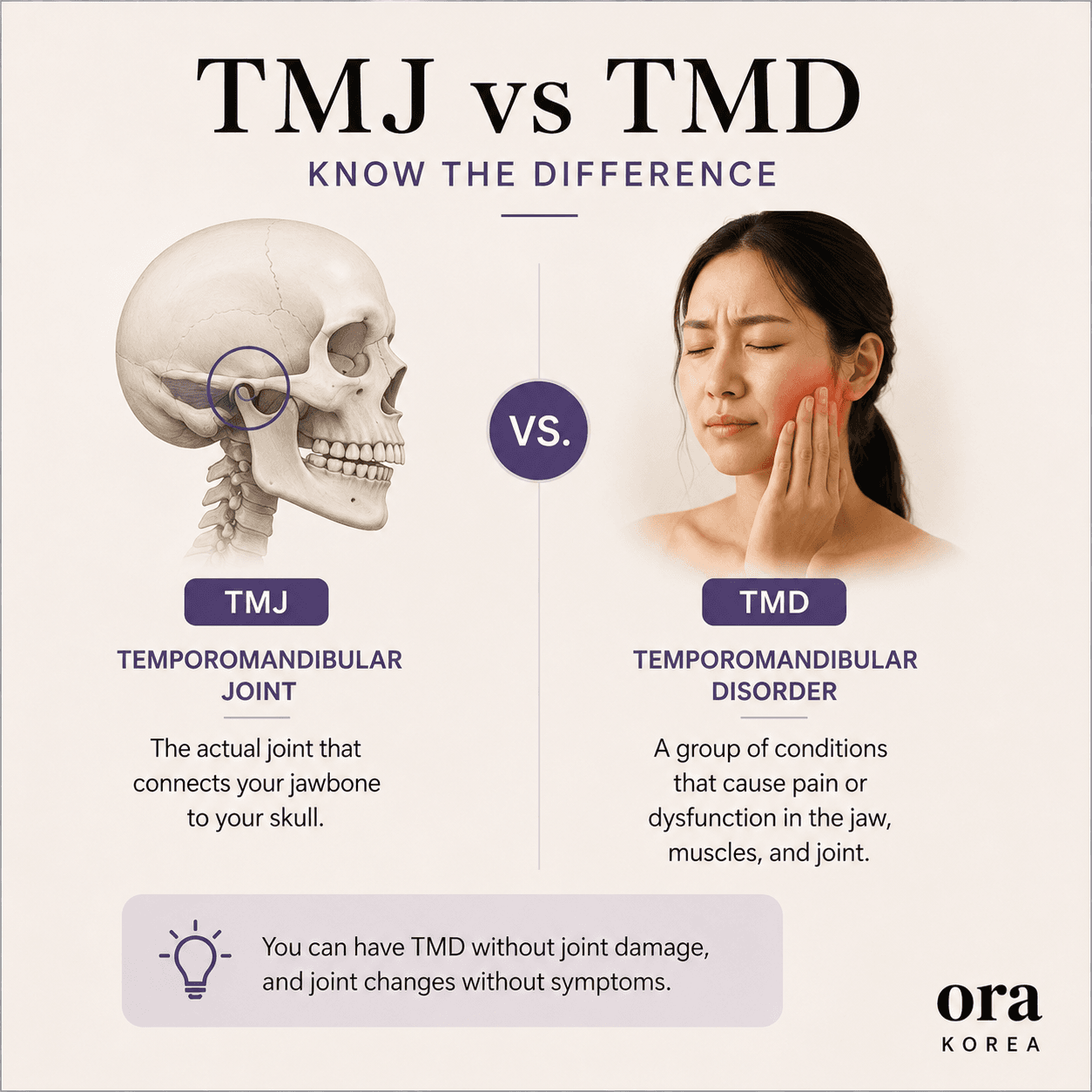
The TMJ is the temporomandibular joint, the joint that connects the lower jaw to the skull in front of the ear. You use it every time you chew, speak, yawn, or open your mouth. TMD stands for temporomandibular disorders. It refers to a group of problems involving the jaw joint, chewing muscles, or related structures.
TMD can show up as jaw pain, facial pain, headaches, ear-area discomfort, clicking, popping, locking, limited opening, chewing pain, or a tired jaw. It can be muscle-driven, joint-driven, tooth-driven, habit-driven, stress-related, bite-related, inflammatory, traumatic, or mixed.
That is why diagnosis matters. If the real problem is an infected tooth, an impacted wisdom tooth, a cracked crown, gum disease, or a joint disc issue, Botox alone may miss the reason the pain exists.
When Botox may help
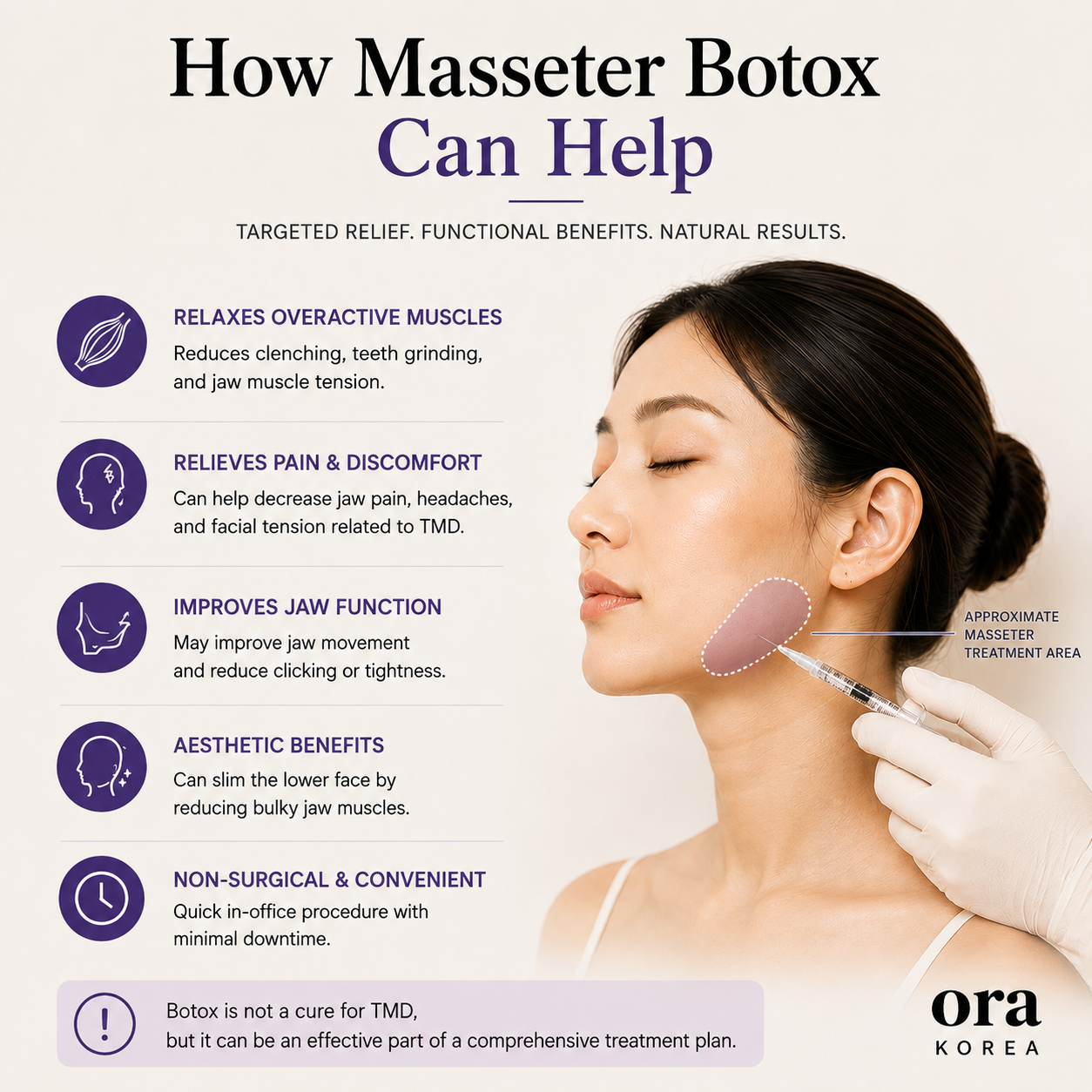
Botox and other botulinum toxin products relax muscles by reducing the signal that tells the muscle to contract strongly. In jaw cases, injections are often placed in the masseter and sometimes other chewing muscles. For selected patients, this can reduce muscle intensity, jaw fatigue, clenching force, and pain related to overactive chewing muscles.
This is the clearest fit: a patient has strong masseter overactivity, clenching, grinding-related muscle soreness, or jaw fatigue linked to large chewing muscles. In those cases, masseter Botox may be part of a broader relief plan. It can be especially attractive in Korea because public clinic pricing can be much lower than in many Western markets.
But help is not the same as cure. Botox does not rebuild damaged teeth. It does not remove infection. It does not fix a displaced joint disc. It does not teach the nervous system to stop clenching. It also does not replace a splint, bite evaluation, physical therapy, habit coaching, sleep evaluation, dental treatment, or stress-related care when those are the real drivers.
When Botox may not be enough
Botox may be the wrong first step if the pain is sharp, one-sided, tooth-specific, or triggered by biting on a particular tooth. It may not solve symptoms caused by decay, abscess, cracked teeth, failing crowns, gum infection, nerve pain, or impacted wisdom teeth. It may also be incomplete when the jaw joint locks, the bite suddenly changes, or opening is severely limited.
It is also worth slowing down if a clinic treats every jaw complaint as a Botox case. TMD is not one diagnosis. A good provider should ask about symptoms, timing, chewing, headaches, grinding, sleep, dental history, trauma, medications, and prior orthodontic or restorative work. They may examine the teeth, gums, jaw muscles, jaw opening, bite contacts, and joint sounds. Imaging may be useful in selected cases.
If the clinic cannot explain what type of jaw problem they think you have, the injection plan is probably ahead of the diagnosis.
What prices should patients expect in Korea?
An easier way to read the range:
Korean-brand promotions: about KRW 80,000 to KRW 200,000, or roughly USD 60 to USD 145.
Imported or premium products: usually higher than the lowest Korean-brand promotions.
Higher-touch cases: about KRW 300,000 to KRW 450,000, or roughly USD 220 to USD 330, depending on dose, muscle size, brand, and how much evaluation is included.
Big picture: plan for roughly KRW 80,000 to KRW 450,000, or about USD 60 to USD 330, but compare what is included rather than only the lowest price.
A very low price is not automatically suspicious. Korea has domestic botulinum toxin brands, competitive aesthetic clinics, and high treatment volume. But the cheapest price may only cover a basic cosmetic injection. It may not include a dental exam, TMD diagnosis, bite evaluation, splint discussion, follow-up, or management if symptoms change.
For a patient with real jaw pain, the better question is not only, "How much is masseter Botox?" It is, "Who is evaluating why my jaw hurts, and what happens if Botox is not the right treatment?"
Korean Botox brands vs imported brands
Patients often search for Korean Botox versus Allergan, Xeomin, Dysport, or other botulinum toxin products. Korea has domestic toxin brands that may be priced lower than imported brands. Imported products may cost more because of brand recognition, supply chain, clinic positioning, or patient preference.
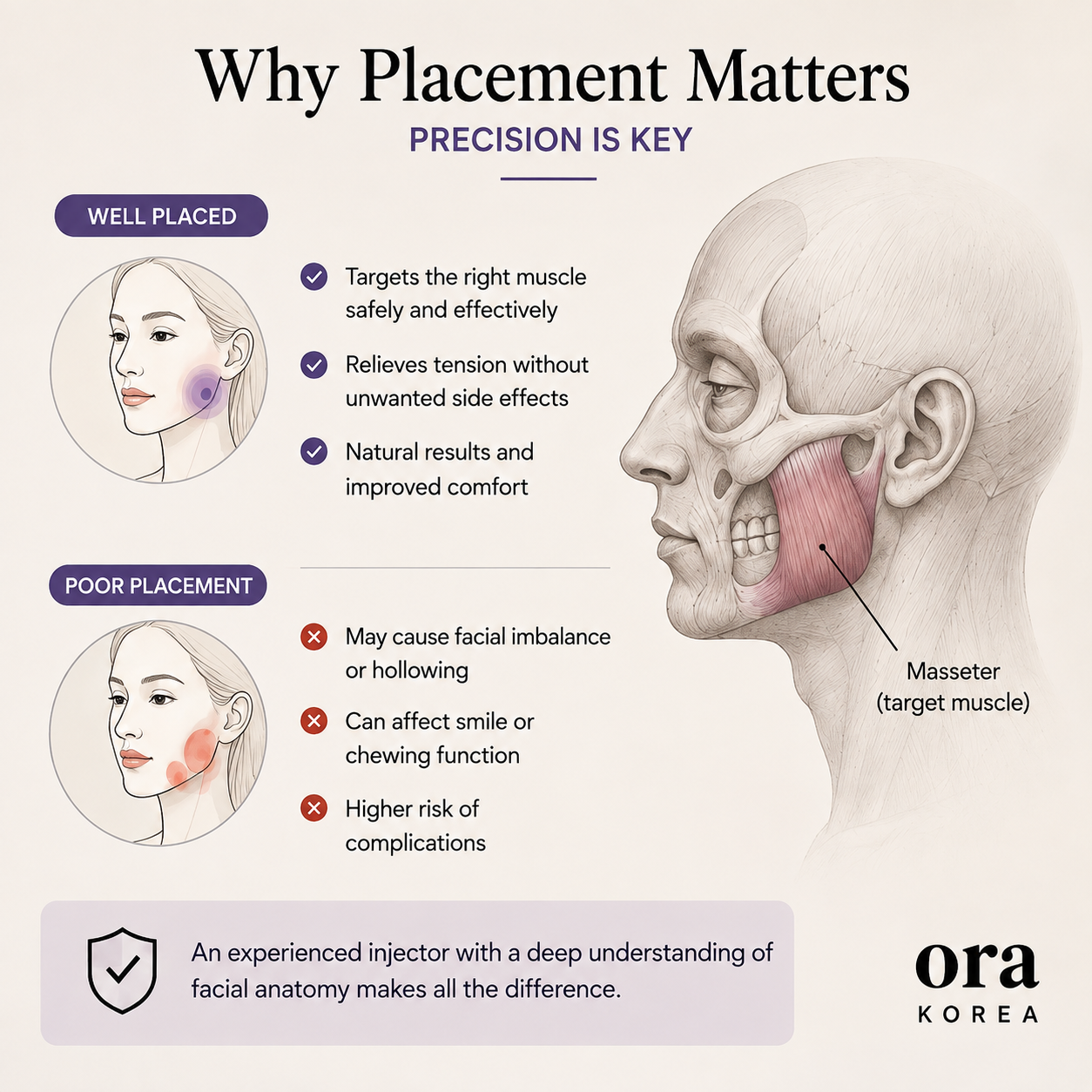
Brand matters, but it is not the only thing that matters. Dose, dilution, injection placement, muscle assessment, follow-up timing, and whether the treatment goal is pain relief, bruxism support, or cosmetic slimming all affect the result. A skilled injector using a lower-cost product may be safer than a clinic using a famous brand without a proper evaluation.
Patients should ask which product is being used, how many units are planned, whether the price is per side or total, and why that dose fits their jaw muscles and symptoms.
Risks and side effects to understand
Botulinum toxin injections are common, but they are still medical treatment. Possible local side effects include bruising, soreness, temporary chewing weakness, smile asymmetry, change in facial contour, headache, or an over-relaxed chewing muscle. Larger or repeated doses into chewing muscles may raise concern about changes in muscle size and possibly bone or joint loading over time, especially if treatment is repeated without reassessment.
Botulinum toxin products also carry serious safety warnings about toxin effects spreading beyond the injection area, although this is uncommon in cosmetic dosing. Patients should understand warning symptoms such as trouble swallowing, speaking, or breathing, and should seek urgent medical care if severe symptoms occur.
For TMD specifically, major patient resources describe Botox evidence as mixed, and in the United States Botox is not FDA-approved for TMD. That does not mean it is never used. It means patients should treat it as a selected, clinician-guided option rather than a simple guaranteed cure.
What else may be part of TMD care?
Many TMD cases start with conservative care. Depending on the diagnosis, a dentist or orofacial pain clinician may discuss habit awareness, reducing daytime clenching, avoiding gum chewing, temporary soft-food periods, heat or cold, anti-inflammatory medication when appropriate, physical therapy, jaw exercises, sleep and stress contributors, or an occlusal splint/night guard.
Dental work may matter too. A cracked tooth, high crown, missing tooth, unstable bite, impacted wisdom tooth, or gum infection can change how the jaw muscles behave. Orthodontic history, recent crowns, veneers, implants, or bite changes may also be relevant.
The best plan is often layered. Botox may reduce muscle force while the underlying contributors are evaluated. Or Botox may be unnecessary once the actual dental or joint issue is treated.
Red flags
Be careful if a clinic promises to cure TMJ with Botox after only looking at your face shape. Be careful if no one asks about tooth pain, bite changes, sleep, clenching habits, prior dental work, or jaw locking. Be careful if the clinic will not name the product, dose, injector qualification, or follow-up plan.
Also be careful with packages that make repeated masseter Botox sound routine forever. Some patients benefit from repeat treatment, but repeated weakening of chewing muscles should be reassessed, especially if the goal is symptom control rather than a one-time cosmetic effect.
Where Ora Korea can help:
Korea can be a good place to receive Botox and jaw-related dental care, but TMD deserves more respect than a menu item. The patient is not just buying a quick injection or a lower price. They are trying to understand pain, function, chewing, sleep, teeth, muscles, and sometimes irreversible dental history.
Ora Korea exists to help patients separate a useful treatment from a convenient advertisement. For some patients, masseter Botox may be a sensible part of the plan. For others, the safer move is dental diagnosis, imaging, splint therapy, physical therapy, infection treatment, bite correction, or simply more time before doing anything permanent.
FAQ
Is TMJ Botox available in Korea?
Yes, many Korean clinics offer masseter or jaw Botox, and some patients seek it for clenching, grinding, jaw tension, or TMD-related muscle symptoms. The important question is whether the clinic is diagnosing the jaw problem or simply offering a cosmetic injection.
Does Botox cure TMD?
No. Botox may help selected muscle-driven symptoms, but TMD can have many causes. It does not cure joint problems, infected teeth, cracked teeth, gum disease, bite changes, or every form of jaw pain.
How much does TMJ or masseter Botox cost in Korea?
A simple planning range is KRW 80,000 to KRW 450,000, or roughly USD 60 to USD 330. Lower Korean-brand promotions may sit around KRW 80,000 to KRW 200,000, while imported brands or higher-touch cases may be closer to KRW 300,000 to KRW 450,000. Always confirm product, dose, total vs per-side pricing, and whether a jaw/TMD evaluation is included.
Is Korean Botox safe?
Licensed botulinum toxin products can be used safely by trained clinicians, but safety depends on product sourcing, dose, injection site, medical history, and follow-up. Patients should avoid unclear products, pressure selling, and clinics that cannot explain side effects or warning signs.
Is jaw slimming the same as TMJ Botox?
No. Jaw slimming Botox usually aims to reduce the size or appearance of the masseter muscle for facial contouring. TMJ/TMD Botox is about symptom relief: jaw tension, clenching, grinding, chewing fatigue, or muscle-related pain. A separate Ora Korea article will cover slimming and when an aesthetic approach is appropriate.
Sources used
NIDCR: Temporomandibular disorders
NIDCR: Temporomandibular disorders and jaw pain data
National Academies: Caring for individuals with TMD
American Association of Endodontists: Botulinum toxin for orofacial pain management
DailyMed: BOTOX Cosmetic prescribing information
Found this useful?

Written by
Dr. John Yoo
Columbia-trained, U.S. based dentist guiding people who come to Ora with proper follow-up care, dentist to dentist communication, and long-term support.