Treatment guide · Cost & value
How Much Does Dental Work Cost in Korea? A Foreigner-Friendly Price Guide
Compare pricing, materials, doctor involvement, clinical reputation, and follow-up before choosing a clinic.

Written byOra Korea
Updated August 2026
7 min read
The short answer
- Korea can offer affordable dental care, from basic visits to promotional whitening and larger treatment plans. The smartest choice is the clearest quote, not simply the cheapest one.
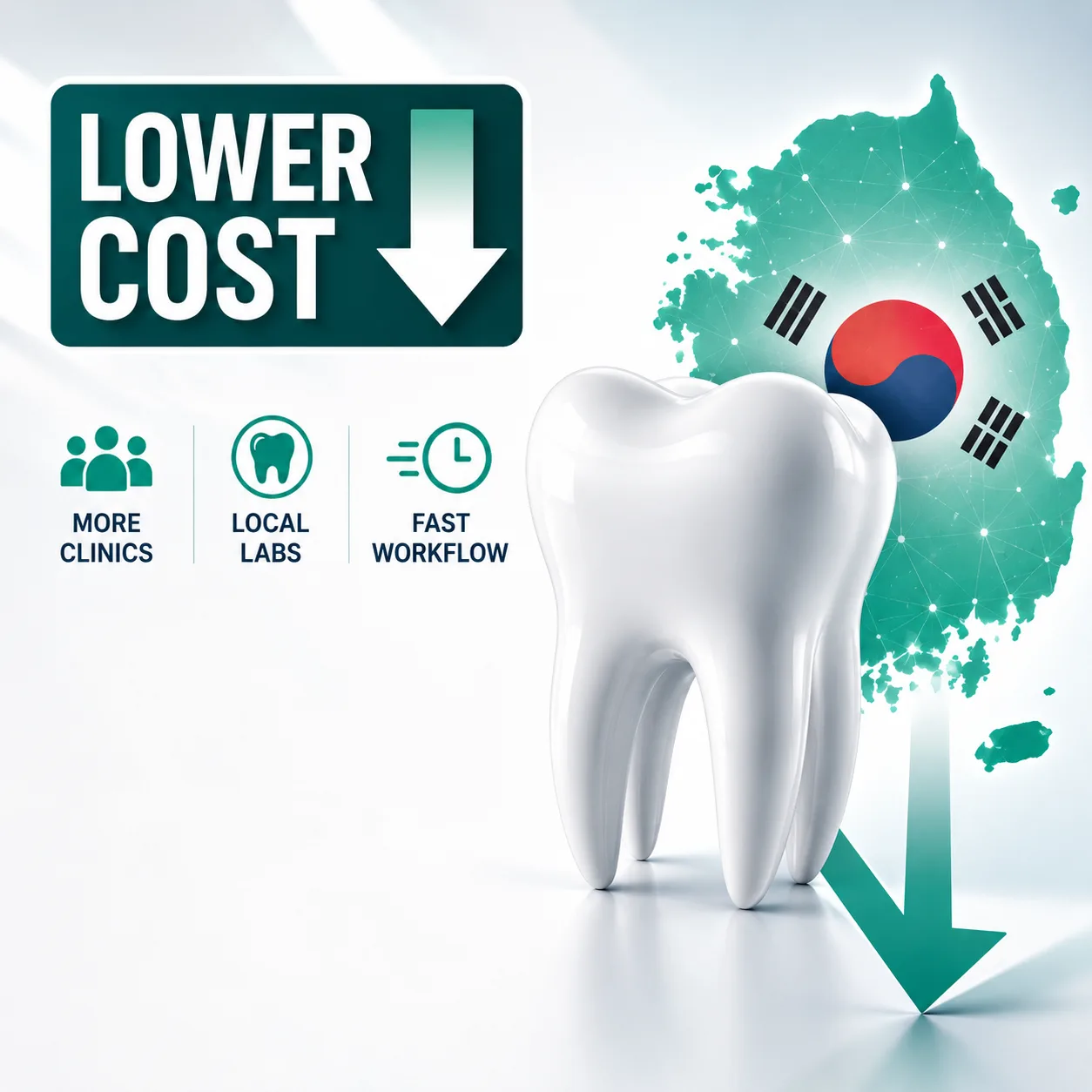
Dental prices in Korea can be attractive compared with many Western countries, and some promotional offers can be surprisingly affordable. The real question is not “What is the cheapest price?” The better question is: what is included, what could change after examination, and which clinic is the right fit for the treatment?
Typical price ranges patients should expect
Do not read these numbers like a restaurant menu. Dental quotes in Korea usually fall into a few simple groups: small visit fees, per-tooth fees, surgery fees, and larger treatment-plan fees.
These are planning ranges, not guaranteed quotes. Korea also has promotional pricing, especially for cosmetic add-ons or first-visit offers, so a clinic may advertise a lower entry price than the standard range. The final price still depends on diagnosis, tooth position, material, doctor involvement, lab work, imaging, anesthesia, and whether extra procedures are needed.
Promotional and entry-level prices can be real
Promotional prices are common for treatments that are easy to explain upfront, such as whitening, scaling, consultation bundles, basic cosmetic trials, or seasonal new-patient events. Whitening may be advertised around KRW 100,000 (about USD $70) during a promotion, while standard professional in-office whitening is often closer to KRW 250,000-600,000 (about USD $180-$430) per session and larger packages can cost more. That does not make the lower price bad; it just means you should confirm what the offer includes.
A simple way to read Korean dental prices
Small visit fees: usually under KRW 300,000 (about USD $215)
These are the simpler appointment-based items.
Consultations or basic exams are usually KRW 30,000-100,000 (about USD $20-$70), X-rays or 3D CT scans KRW 20,000-150,000 (about $15-$105), cleaning/scaling KRW 50,000-150,000 (about $35-$105), and simple fillings KRW 80,000-300,000 per tooth (about $55-$215).
Whitening: promotions may be around KRW 100,000 (about USD $70); standard visits often cost more
Whitening can be one of the more affordable cosmetic dental options in Korea. Some promotions advertise around KRW 100,000 (about USD $70), especially for limited-period or introductory offers. Standard in-office whitening is more often KRW 250,000-600,000 (about USD $180-$430) per session, and multi-visit or combined take-home packages can reach KRW 900,000 or more (about USD $640+). Compare the number of cycles, system used, sensitivity care, scaling, and take-home maintenance before deciding.
Per-tooth lab work: often KRW 500,000-1,300,000 (USD $360-$930) per tooth
These treatments are usually priced per tooth because they involve custom lab work.
Crowns are usually KRW 500,000-1,100,000 per tooth (about USD $360-$785), while veneers are KRW 500,000-1,300,000 (about $360-$930). Root canal treatment is often KRW 150,000-800,000 (about $105-$570), with the crown usually priced separately.
Surgery and implants: the range depends heavily on complexity
Simple wisdom tooth removal often costs KRW 100,000-200,000 (about USD $70-$140), while impacted or surgical removal is roughly KRW 300,000-800,000 (about $215-$570). A straightforward single implant with crown is often KRW 1,200,000-3,000,000 (about $860-$2,140).
Implants are one of the easiest prices to misunderstand. Some quotes include only implant placement. Others include the fixture, abutment, final crown, CT scan, medication, temporary tooth, and follow-up. Bone grafting, sinus lift, sedation, or premium implant systems can raise the total.
Bigger planned cases: usually several million won or more
These are not usually one-line prices because the treatment design changes the total.
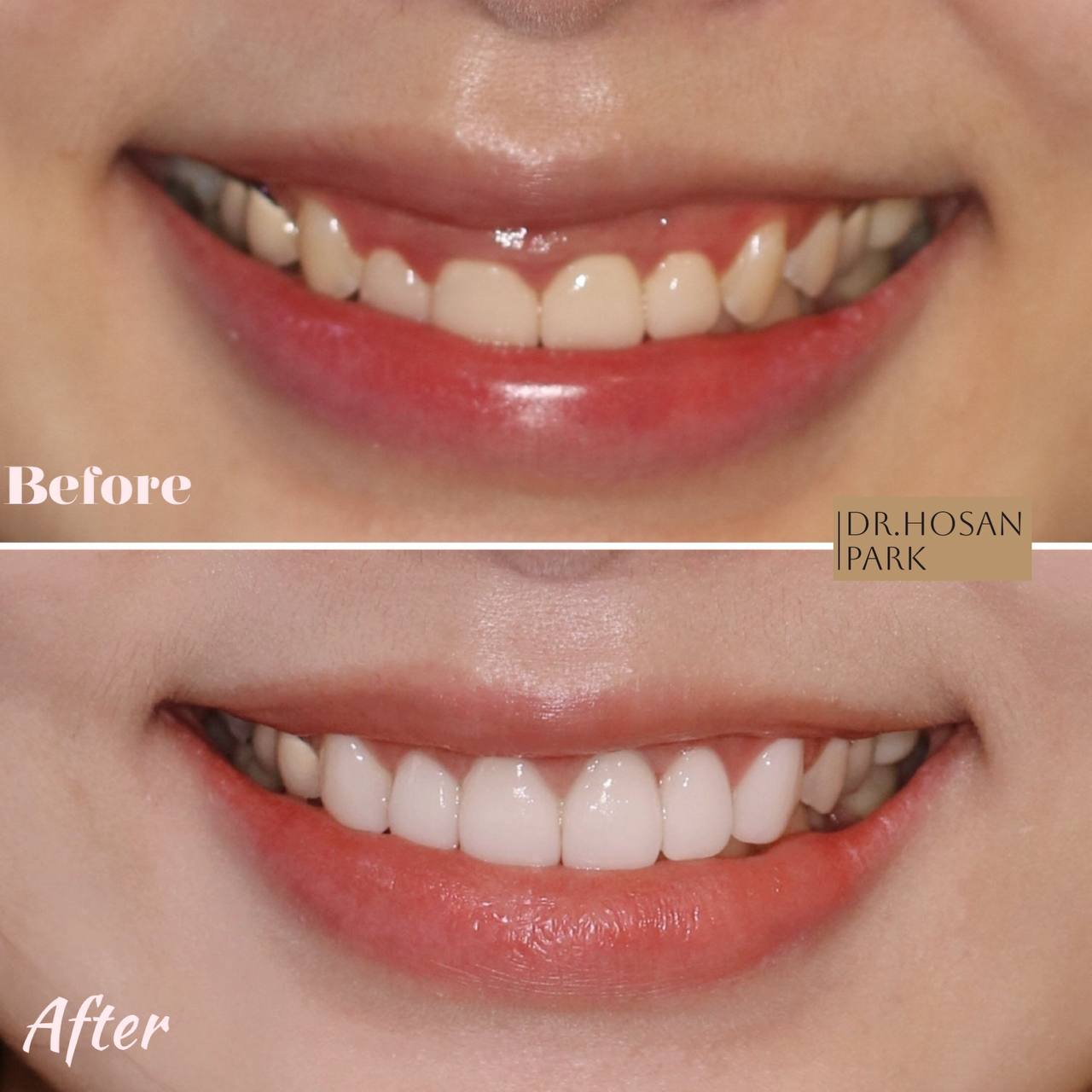
Clear aligners, multiple veneers or crowns, and full-mouth plans are usually quoted as larger treatment plans. Several million won is roughly USD $2,000 or more; the final total depends on tooth count, implants, grafting, temporary teeth, final materials, and follow-up.
Quick examples
Cleaning plus whitening is usually a small-to-medium visit cost, while crowns and veneers are usually priced per tooth. For implants, compare the full package: fixture, abutment, crown, CT scan, grafting, temporary tooth, and follow-up.
Where the savings usually matter most
Korea is usually most cost-effective when treatment involves lab-made restorations, cosmetic planning, implants, or multiple teeth. The savings are usually less meaningful for small one-off treatments because flights, hotels, time off work, and follow-up logistics can erase the difference.
Best-fit cases for meaningful savings
Savings are usually most meaningful for multiple crowns or veneers, implant treatment, full-mouth plans, and multi-tooth cosmetic design, especially if you already planned to be in Korea.
The main point: compare complete treatment plans, not menu prices. A lower quote can be legitimate, but only if you understand exactly what is included.
What to compare before deciding it is a good deal:
Compare the same number of teeth, materials or implant brand, imaging, lab work, temporary restorations, and treatment timeline. Then check who performs the treatment, what follow-up is included, and whether there is a clear remake or warranty policy.
USD estimates are rounded using KRW 1,400 = USD $1 for planning only. Exchange rates move, so recalculate before paying or wiring a deposit, especially for larger plans.
Why dental prices vary so much
Dental pricing depends on more than the procedure name. Two patients can both search for “implant cost Korea” and receive very different quotes because their cases are different.
Why prices can be lower without lower-quality materials
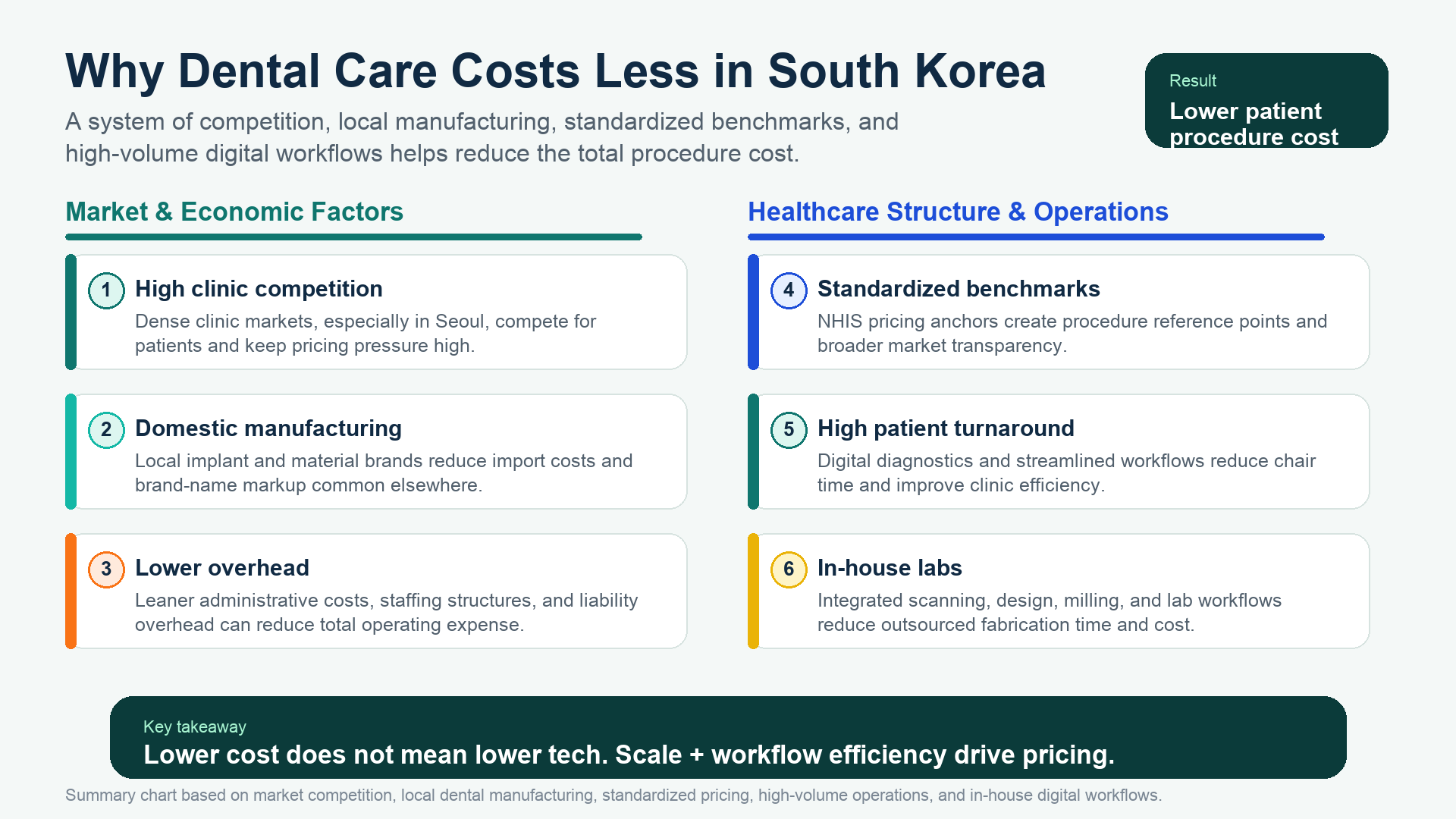
A lower Korean price does not automatically mean lower-quality materials. Many clinics use the same global implant systems, zirconia blocks, ceramic materials, scanners, CT machines, and CAD/CAM workflows used in Western private dentistry. In some clinics, the technology and lab workflow may be more modern than what a patient has seen at home.
The price difference often comes from the structure of the market around the treatment, not only the material inside the mouth.
Common reasons include:
Seoul's dense clinic competition and high treatment volume can lower overhead per case. Nearby labs and digital workflows - scanning, CBCT, CAD/CAM, milling, 3D printing, and guided implant planning - can also shorten turnaround and reduce coordination costs.
Korean clinics may also operate with different staffing, insurance, and administrative costs than Western practices. Strong cosmetic demand and established medical-tourism support mean many clinics are used to high-volume aesthetic planning and international patients.
The takeaway: a lower Korean quote can still be a strong quote, even when the clinic is using good materials. But patients should still compare what is included, who performs the treatment, what material or brand is used, what lab is involved, and how follow-up is handled.
What can change the final price
Prices can change with the diagnosis, tooth position, material, bone or gum condition, number of visits, lab work, sedation, temporary restorations, follow-up, and whether a specialist is involved.
A good clinic should explain why your quote is what it is.
Common dental treatments foreign patients ask about
Cleaning and scaling
Often one of the easiest treatments to schedule during a Korea trip. Pricing may depend on whether the visit includes exam, X-rays, polishing, or additional gum care.
Teeth whitening
Whitening may be priced per session, per cycle, or as a package. Ask whether scaling, exam, gum protection, and take-home trays are included.
Fillings
Costs depend on size, material, location, and whether decay is close to the nerve. A simple filling and a deep restoration are not the same thing.
Crowns
Crown cost depends on material, tooth location, lab work, whether a root canal is needed, and whether a temporary crown is included.
Veneers
Veneer pricing depends on material, number of teeth, smile design planning, temporaries, bite issues, and whether gum or orthodontic treatment is needed first.
Implants
Implant pricing can vary significantly. Ask whether the quote includes the implant fixture, abutment, crown, CT scan, bone graft, sinus lift, temporary tooth, medication, and follow-up.
Clear aligners / Invisalign
Pricing depends on case complexity, aligner brand, number of trays, refinements, retainers, and visit schedule.
What to ask before trusting a quote
Before booking, get these points in writing:
Ask what is included and excluded, whether the price can change after examination, and whether X-rays or CT scans are required. Confirm the material or brand, number of visits, treating doctor, follow-up plan, English-language support, and payment or deposit terms.
Keep the questions simple. You are not trying to negotiate every detail. You are trying to avoid surprises.
Low price vs clear price
A low advertised price may be real, but it may not include everything. For example, an implant price may exclude bone grafting, abutment, final crown, or CT imaging. A veneer price may not include temporaries, gum contouring, or bite-related adjustments.
Promotional prices are useful when they help you start a conversation, but they should not be the only reason to choose a clinic. For implants, ultra-low ads may refer only to one component, not the fixture, abutment, crown, CT scan, medication, temporary tooth, grafting, sedation, or follow-up. For whitening, a KRW 100,000 (about USD $70) promotion may be a limited session rather than a full package. Cheapest is not necessarily best; the better deal is complete, clinically appropriate, and clear in writing.
That does not mean the clinic is doing anything wrong. It means the patient needs to compare full plans, not headlines.
For foreign patients, the risk is not only cost. The bigger risk is misunderstanding the diagnosis, rushing the timeline, or leaving Korea without a clear follow-up plan.
Dentist note
If a quote sounds too simple for a complex case, slow down. Good dentistry usually starts with diagnosis, not a menu price.
How to compare clinics fairly
Compare clinics using the same information:
Compare the same treatment and tooth area, material, imaging, number of visits, inclusions, follow-up, English support, and the doctor's experience with that procedure.
The clinic with the highest price is not automatically best. The clinic with the lowest price is not automatically risky. The best option is the one that gives a clear diagnosis, reasonable plan, and transparent quote.
Sources
- Lucid Dental Clinic: Dental treatment costs in Korea, Lucid Dental Clinic
- Lucid Dental Clinic: Tooth whitening in Seoul, Lucid Dental Clinic
- Med in Korea: Dental implants in Korea cost and timeline, Med in Korea
- Korea.net: Foreign Patients Surpass 2 Million in 2025, Korea.net
- OECD: Dentists dataset, OECD
Found this useful?
