
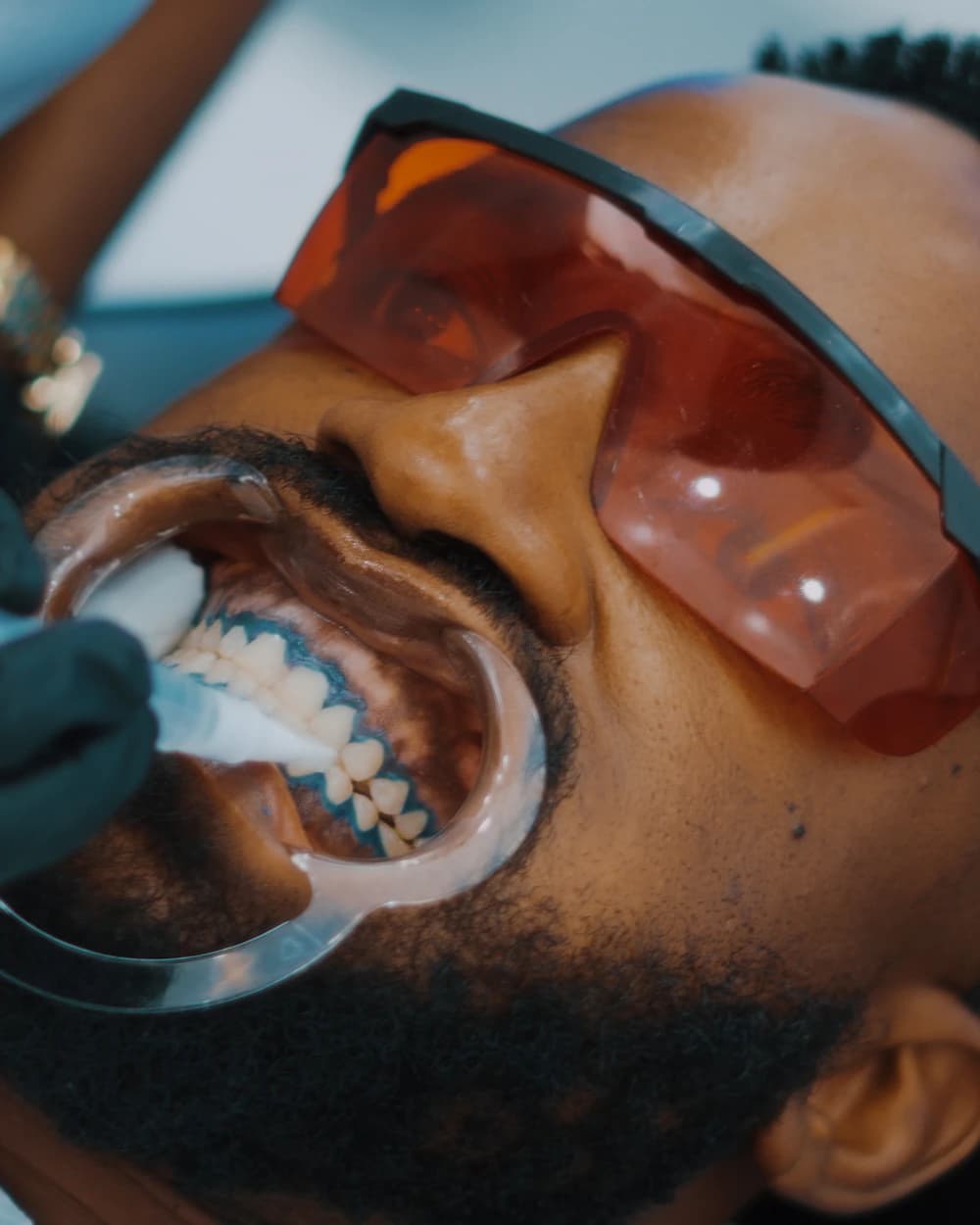
A patient came in recently asking for veneers on eight teeth. After I looked, I told her she needed a whitening tray and about twenty minutes of bonding on one chipped edge: a fraction of the cost, and none of it permanent. She left a little stunned that a dentist had argued her down.
Three treatments get pitched for the same complaints ('my teeth are stained,' 'this one's chipped,' 'my smile looks uneven'), and they are wildly different in cost, permanence, and how much of your natural tooth they cost you. Choosing well is mostly about matching the treatment to the actual problem, and resisting the upsell to the most permanent option when a reversible one would do.
Start with the least permanent: whitening
If your teeth are well-shaped and reasonably aligned but simply darker or yellower than you'd like, professional whitening is almost always the right first move. It changes color and nothing else: no enamel removed, fully reversible in the sense that it does no structural harm, and a fraction of the cost of anything below it on this list. Its limits are honest ones: it doesn't change shape, it doesn't work on crowns or fillings, and results fade and need topping up. But for a pure color problem, nothing else should come first.

The middle rung: composite bonding
For small, specific problems (a chipped edge, a slightly short tooth, a small gap, a minor shape irregularity), composite bonding is the underrated middle option. The dentist builds up tooth-colored resin directly, usually in one visit, removing little or no enamel. It's reversible, far cheaper than veneers, and repairable if it chips. The trade-off is honest: composite stains over a few years and isn't as hard or long-lasting as porcelain. For a couple of teeth, or for a younger patient, it's often exactly right.
The top rung: veneers
Veneers are the right tool when the case is genuinely big: multiple teeth that need both color and shape changed, a smile you want fundamentally redesigned, or discoloration that whitening can't touch (like deep internal staining). Porcelain is beautiful, stain-resistant, and long-lasting, and it's permanent, because enamel is removed to place it. That permanence is why veneers belong at the top of the ladder, reached only when the rungs below genuinely can't solve the problem.
The one-line rule
Use the least invasive treatment that actually solves your problem. If whitening would do it, don't bond. If bonding would do it, don't veneer. Every step down the permanence ladder keeps more of your own tooth.
How to use this when comparing clinics
This ladder is also a test you can run on any clinic, at home or in Seoul. Describe your complaint and see where they start. A clinic that reaches for the reversible option first, and reserves veneers for cases that need them, is thinking about your teeth. One that answers every cosmetic question with 'veneers' is thinking about its schedule. It's the same signal we describe in why we tell some patients not to get veneers, and it's worth flying for.